

Article Summary
- California law may allow multiple individuals to create a trust together, but legality does not guarantee good planning.
- Property tax reassessment and gift tax consequences can arise when unrelated individuals share trust ownership.
- Community property rules can create complications for married individuals considering these arrangements.
- Trusts are made for estate planning, not shared business governance or co-ownership management.
- LLCs and corporations often provide a cleaner framework for shared ownership and operational continuity.
People ask this question for understandable reasons. A sibling helps manage family property, an unmarried partner shares real estate ownership, a business partner feels like family, or parents want to simplify intergenerational transfers.
The legal question sounds simple: Can two people create a Revocable Living Trust together if they are not married?
Sometimes they can. The better question is whether they should. While California law may allow non-spouses to create a trust together in certain situations, shared trust arrangements often create tax, ownership, and governance complications that are overlooked until problems arise.
Understanding Joint Revocable Trusts for Non-Spouses
California law does not generally prohibit multiple people from establishing a trust together. Under certain circumstances, unrelated individuals may create a joint Revocable Living Trust.
The legal ability to create a trust is not the primary concern. The more important question is what happens after the trust is funded and begins interacting with real-world ownership, tax, and succession issues.
When multiple unrelated parties place assets into the same trust, several planning considerations immediately arise:
- Ownership rights
- Control authority
- Tax consequences
- Creditor exposure
- Future transfers
- Succession planning
These issues often become far more important than the trust document itself. A structure can be legally valid while still being strategically flawed.
Why Married Couples Are Different
Married couples often use a trust together because the law already treats their ownership interests differently. Spouses frequently hold assets as:
- Community property
- Joint tenancy
- Shared marital property
California is a community property state. When married couples transfer jointly owned assets into a trust, the planning often aligns with existing ownership rights and marital property rules.
Many people assume a shared Revocable Living Trust operates the same way for unmarried partners, siblings, or business associates. In reality, those relationships involve entirely different legal and tax considerations.
Ownership rights that appear simple outside the trust can become much more complicated once trust administration, distributions, amendments, and future transfers are considered.
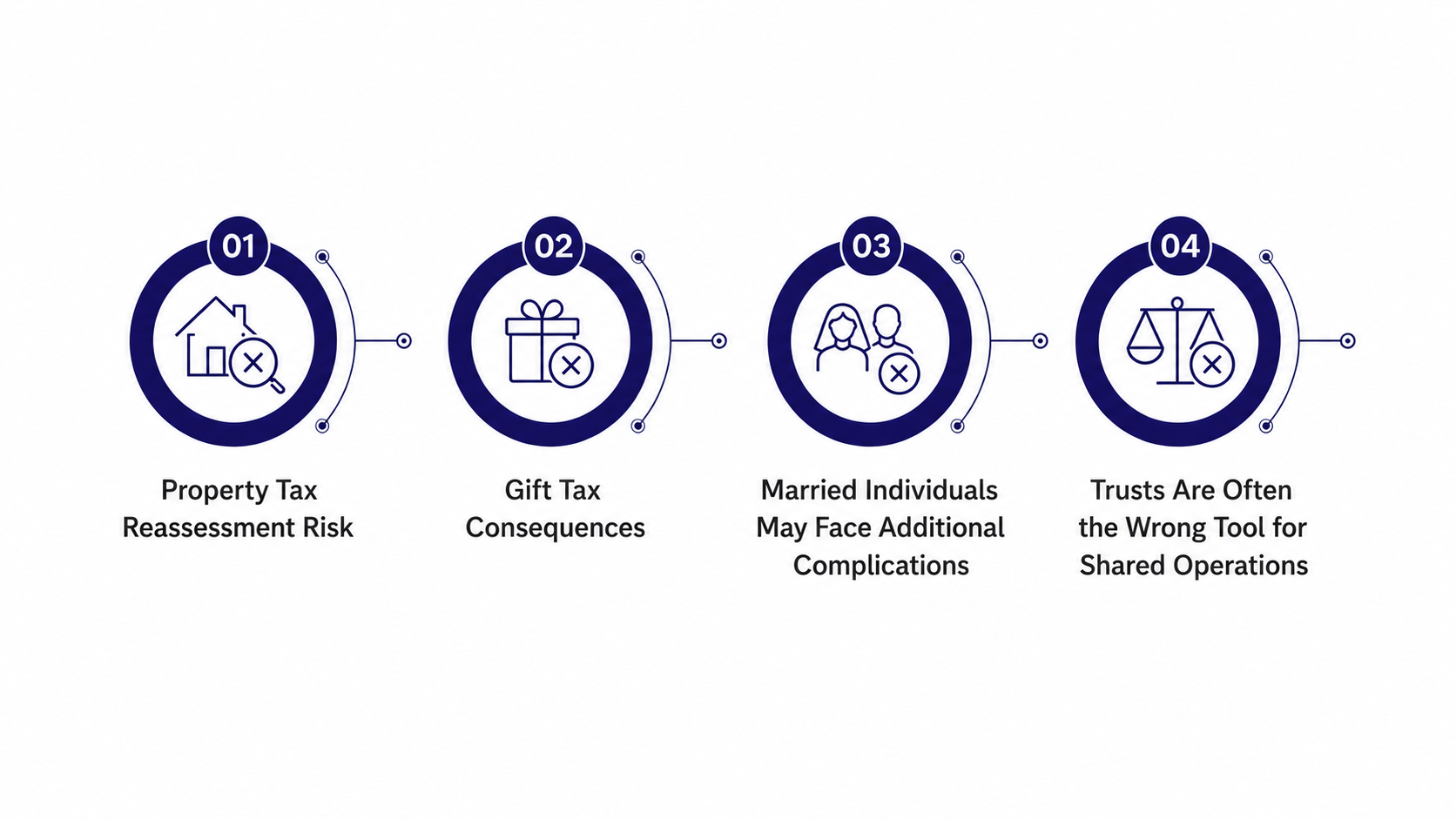
Problem #1: Property Tax Reassessment Risk
California’s property tax system generally limits annual increases in assessed value under Proposition 13. Certain ownership changes, however, can trigger reassessment.
Consider the following concerns:
|
Risk |
Why It Matters |
|
Change in ownership |
May trigger reassessment |
|
Trust ownership restructuring |
May affect tax treatment |
|
Transfers between unrelated parties |
Often receive additional scrutiny |
For individuals holding highly appreciated California real estate, even a modest change in ownership can have meaningful financial consequences.
Many people focus exclusively on trust creation while overlooking how transfers into the trust affect existing property tax treatment. A trust should never be evaluated separately from the assets being transferred into it.
Problem #2: Gift Tax Consequences
When one person contributes property and another individual receives beneficial rights, the transaction may create gift tax considerations depending on how the trust is structured. Potential concerns include:
- Unequal contributions
- Different beneficial interests
- Unclear ownership percentages
- Different revocation powers
- Unequal distribution of rights
Federal gift tax rules under Internal Revenue Code Chapter 12 may become relevant when ownership rights shift between unrelated parties.
This does not automatically mean taxes will be owed. It does mean the transaction deserves careful review before assets are transferred.
Many people searching for Revocable Living Trusts assume that trust planning focuses exclusively on probate avoidance. Tax consequences often become part of the conversation much sooner than expected.
Problem #3: Married Individuals May Face Additional Complications
You may believe an asset belongs entirely to you because:
- The title is in your name
- You acquired it years ago
- You manage it personally
That does not automatically make it separate property. California community property rules can significantly affect ownership rights. If you are married, transferring assets into a trust with someone other than your spouse may create concerns involving:
- Community property interests
- Fiduciary duties
- Marital ownership disputes
- Title complications
- Future claims regarding ownership rights
Before creating a trust arrangement with a non-spouse, ownership rights should be analyzed carefully to determine whether third-party participation creates unintended complications.
Problem #4: Trusts Are Often the Wrong Tool for Shared Operations
A Revocable Living Trust is primarily an estate planning tool. Its primary purposes generally include:
- Probate avoidance
- Incapacity planning
- Asset management
- Wealth transfer coordination
- Continuity for personal assets
Those goals differ significantly from shared business operations or ongoing co-ownership arrangements.
Questions begin appearing immediately:
- Who can amend the trust?
- Who can revoke it?
- What happens during disagreements?
- What happens if one creator becomes incapacitated?
- What happens if one creator dies?
- What happens when a creditor appears?
The discussion quickly shifts away from estate planning and into governance.
Many people researching how to set up a Revocable Living Trust are really attempting to solve ownership and management issues that a trust was never intended to address.
Why LLCs and Corporations Often Work Better
An LLC or corporation is designed to facilitate shared ownership.
|
Structure |
Primary Purpose |
|
Revocable Living Trust |
Estate transfer and incapacity planning |
|
LLC |
Shared ownership and operational management |
|
Corporation |
Governance, continuity, and equity ownership |
Entity structures offer tools specifically designed for multi-owner relationships:
- Operating Agreements
- Ownership percentages
- Voting rights
- Buyout provisions
- Transfer restrictions
- Succession mechanisms
- Liability separation
Trying to force a trust into that role often creates unnecessary complexity. This becomes especially relevant when evaluating arrangements involving Revocable Living Truss because the underlying objective is often shared control rather than estate planning.
The Bigger Planning Problem
People often receive advice from multiple professionals who focus on separate areas of planning.
- A CPA addresses taxes
- An attorney drafts documents
- A financial advisor discusses investments
- An insurance professional evaluates risk
Each recommendation may be reasonable on its own. The problem occurs when nobody coordinates the entire structure. A trust that appears efficient from one perspective may create unintended consequences elsewhere. For example:
- Tax planning may conflict with ownership goals
- Ownership structures may create property tax concerns
- Estate planning documents may not align with business succession plans
- Asset protection strategies may create governance complications
The best structure is the one that aligns multiple objectives without creating new ones.
Build the Right Structure for Your Long-Term Goals

Good planning is rarely about finding a legal workaround. It’s about choosing the right structure for the right objective.
If your goal is shared ownership, business continuity, investment coordination, or multi-party control, a Revocable Living Trust may solve the wrong problem, creating risk disguised as simplicity.
Dahl Law Group approaches these questions through its Strategic Planning Counsel for Business Owners™ framework: One Team. One Strategy. Everything Aligned. This means coordinating estate planning, business structuring, tax strategy, asset protection, and succession planning together, rather than solving one issue while quietly creating three more.
FAQs
- Can unmarried partners create a joint trust in California?
Potentially yes, but ownership rights, tax consequences, and governance concerns should be evaluated carefully before moving forward.
- Does transferring property into a trust trigger property tax reassessment?
It can, depending on the nature of the transfer, ownership structure, and applicable California property tax rules.
- Can putting assets into a shared trust create gift tax concerns?
Yes. Certain transfers that confer beneficial rights on another individual may require a gift tax analysis.
- Why is a trust often a poor fit for business partners?
Trusts are designed primarily for estate planning. Business entities generally provide stronger governance and ownership frameworks.
- Is an LLC better than a trust for shared ownership?
In many situations, yes. LLCs are specifically designed to address control, ownership percentages, operational management, and continuity.
- Can married individuals transfer community property into a trust with someone else?
Potentially, but community property rights and ownership interests should be analyzed carefully before any transfer occurs.

Dahl Law Group
Latest posts by Dahl Law Group (see all)
- 7 Asset Protection Strategies California Business Owners Must Consider - August 14, 2026