

Article Summary
- Oil and gas investments often advertise large first-year write-offs, but that headline leaves out the California tax treatment.
- Federal law still offers strong tax benefits for oil and gas investment, especially through the IRC §263(c) IDC deduction.
- Federal treatment may also allow bonus depreciation on qualifying TDCs.
- California does not conform to federal bonus depreciation and now disallows the federal IRC §263(c) deduction for oil and gas IDCs paid or incurred on or after January 1, 2024.
- Because federal and California tax rules now differ in a major way, you need to model both results separately before you invest.
Oil and gas investments often get marketed around one idea: large first-year deductions. If you live in California, you need to look closer before relying on that pitch. Federal law and California law now treat these investments very differently, and that gap directly affects your real after-tax outcome.
That’s why you should review these deals with both returns in mind. A projection that looks strong federally may look much weaker once California adjustments are added. If you do not model both systems before investing, you risk overstating the value of the tax benefit.
If you are considering a working interest investment, two cost categories usually drive the result:
|
Cost Type |
What It Covers |
Typical Industry Allocation |
|
Intangible Drilling Costs (IDCs) |
Labor, drilling fluids, fuel, site work, engineering |
Often 60%–90% |
|
Tangible Drilling Costs (TDCs) |
Casing, pumping units, tanks, and wellhead equipment |
Often 10%–40% |
Federal Tax Rules That Drive Oil and Gas Investment Tax Benefits
Federal law still offers meaningful tax benefits for qualifying oil and gas investment activity. Under IRC §263(c), qualifying IDCs are often currently deductible for federal purposes. That is why the IDC tax deduction and the broader IDC deduction remain such a large part of oil and gas tax planning.
TDCs follow a different set of rules. Depending on the asset and timing, some TDC property may qualify for bonus depreciation for federal purposes. That creates a federal result that may include:
|
Federal Category |
General 2026 Federal Treatment |
|
IDCs |
Often, currently deductible under IRC §263(c) |
|
TDCs |
May qualify for 100% bonus depreciation if eligible |
|
Production income |
May also involve depletion analysis later |
This is the part promoters focus on when they discuss an oil and gas investment tax deduction. The problem is that federal treatment is only one part of the analysis.
Check the Working Interest Exception Before You Claim Losses
Many promoters say oil and gas losses can offset any income. That statement needs more precision. Under IRC §469(c)(3), a working interest in oil or gas property is not treated as passive if the interest is held directly or through an entity that does not limit liability. If the investment is held through a liability-limiting entity, the result can change.
Before you rely on this rule, review:
- Whether you hold the interest directly
- Whether you own a General Partnership interest (no personal liability protection) or a Limited Partnership interest (limited personal liability)
- Whether the entity itself limits liability through its governing documents
- Whether the structure matches the tax summary
- Whether your reporting position is defensible
That review is what separates legitimate tax deductions for oil and gas investments from overly broad marketing claims.
California Tax Rules Limit Federal Oil and Gas Tax Benefits
This is where many California investors get caught off guard. California does not conform to federal bonus depreciation under IRC §168(k). California also does not allow the federal IRC §263(c) deduction for intangible drilling and development costs for oil and gas wells paid or incurred on or after January 1, 2024.
That means your federal IDC deduction and your California result may move in very different directions. A deal that yields a large federal deduction may result in much slower California cost recovery. If you are a high-income California resident, that difference can materially reduce the investment’s state-side value in year one.
You should also avoid mixing unrelated tax concepts. For example, the California gas tax usually refers to fuel tax issues, not the income-tax treatment of a working interest investment. Investors sometimes see the phrase and assume it affects the same tax analysis. In most cases, it does not.
California Rules for Recovering Oil and Gas Investment Costs
For California purposes, you should assume a separate depreciation or amortization schedule is needed. The source material for this blog uses a projection model that assumes:
- 85% of the investment is allocated to IDCs
- IDCs are recovered over 5 years
- TDCs have been recovered for over 7 years
That framework may help with planning, but you should not treat it as a universal rule for every offering. California expressly disallows the federal IDC tax deduction for these post-2023 oil and gas costs, so your state reporting needs careful review.
A conservative summary looks like this:
|
Category |
Federal |
California |
|
IDCs |
Often immediately deductible |
California does not allow the immediate federal IRC §263(c) deduction for oil and gas wells paid/incurred after Jan. 1, 2024 |
|
TDCs |
May qualify for 100% bonus depreciation if eligible |
No conformity to federal bonus depreciation; separate California depreciation applies |
Why California Residents Need Separate Tax Modeling
If you are a California resident, the real tax benefit depends on modeling the state and federal treatment separately. If you live in California, your return may show:
- A large federal deduction in year one
- Much lower California deductions over a longer time period
- Separate state and federal basis tracking
- More complicated reporting when income starts, or the investment is sold
So the benefit is not “fully deducted everywhere.” A more accurate description is that federal law may allow favorable first-year deductions, while California spreads or limits those benefits under its nonconforming rules.
That timing difference may still be useful, but only if you model it correctly.
Check These Oil and Gas Tax Details Before You Invest
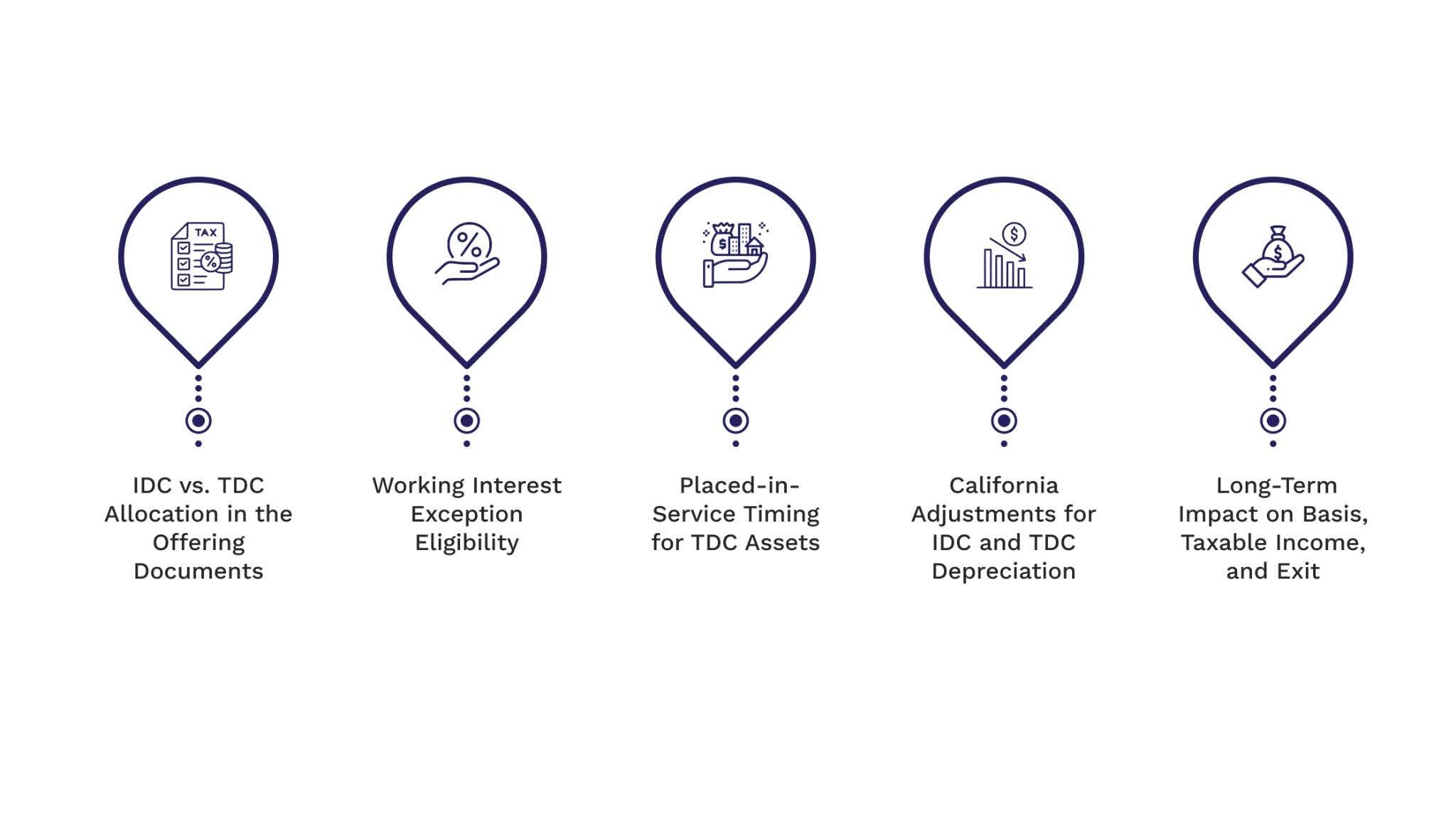 Before you invest, review these five tax details to assess whether the projected benefits are real, usable, and aligned with your situation:
- The actual IDC and TDC allocation in the offering documents
- Whether the structure supports the working interest exception
- The placed-in-service timing for TDC assets
- The California adjustment mechanics for the IDC deduction and depreciation differences
- The long-term effect on basis, future income, and exit planning
Oil and gas tax treatment can be favorable. It can also be oversold. You should focus on whether the projected deductions align with your filing status, income profile, and long-term plan.
Plan for the California Tax Impact Before You Invest

If you are reviewing oil and gas investments as part of a larger tax strategy, Dahl Law Group helps business owners evaluate federal and California treatment, entity structure, asset protection, and estate planning within a single framework. You can also explore the firm’s tax strategy services for related planning support.
You should be aware that federal and state tax laws change periodically, and that any future changes in the law will likely significantly change this analysis.
FAQs
- Can California residents deduct 100% of an oil and gas investment in year one?
Not on the California return. Federal law may allow large first-year deductions, but California does not conform to federal bonus depreciation and does not allow the federal oil-and-gas IDC deduction for post-2023 costs. Review both returns before you rely on any year-one tax projection.
- What are IDCs?
IDCs are drilling costs with no salvage value, such as labor, fuel, drilling fluids, and site work. They often make up most of the upfront spend, which is why they drive much of the federal tax benefit.
- What are TDCs?
TDCs are physical assets, such as casing, tanks, and pumping equipment. Their recovery period and timing can differ sharply between federal and California treatment, so confirm how they are classified in the offering.
- Do oil and gas losses always offset W-2 or business income?
No, that result depends on whether the working interest exception under IRC §469(c)(3) applies and how the investment is held.
- Does California allow federal bonus depreciation for oil and gas investments?
No, California does not conform to IRC §168(k) bonus depreciation for oil and as investments.
- Why do IDC percentages differ across deals?
Because allocations vary by project economics, drilling plan, and asset mix. Always rely on the offering documents, not the marketing summary.

Dahl Law Group
Latest posts by Dahl Law Group (see all)
- 7 Asset Protection Strategies California Business Owners Must Consider - August 14, 2026