

Article Summary
- If you use AI for legal, tax, or board-level advice without counsel, you may create records a court can compel you to produce.
- A 2026 federal ruling warned business owners that AI-generated legal analysis is not privileged when no attorney directs the work.
- You reduce that risk when counsel oversees the work, access stays limited, & confidentiality controls are in place from the start.
- If you use AI on contracts, tax positions, litigation risk, or investigations alone, you create a record of your assumptions, doubts, & decisions.
- You should treat AI legal output like any other business record: involve counsel early, separate legal advice from routine operations, & protect privilege before disputes arise.
Typing a legal question into AI feels efficient. You get a quick answer, a polished explanation, and a draft that seems ready to use. But speed does not create legal protection. Thomson Reuters reported more than 2,200 survey responses across legal, tax, and compliance fields, with nearly 8 in 10 respondents citing AI and GenAI as the main force reshaping professional work. That growth puts business owners at greater risk. If AI replacing lawyers sounds cheaper and faster, what happens to privilege, confidentiality, and control when a dispute begins?
What the Heppner Ruling Means for AI & Privilege
In United States v. Heppner (S.D.N.Y., Feb. 2026), a defendant used Anthropic’s Claude to prepare written analyses of possible defense strategy after receiving a grand jury subpoena. Federal investigators later seized those materials. He argued that the attorney-client privilege protected them, but the court rejected that claim.
The court’s reasoning was straightforward.
|
Issue |
Court’s Finding |
|
Attorney-client privilege |
No qualifying attorney relationship existed |
|
Confidentiality |
No reasonable expectation when using a third-party AI platform |
|
Attorney direction |
Materials were not created at counsel’s direction |
|
Work product doctrine |
Did not apply without attorney involvement |
The court treated the AI platform as a third party rather than as counsel. This distinction is crucial because an attorney-client privilege depends on a protected relationship with a lawyer, not on the fact that the content discusses legal issues, even if your attorney (and not use) use AI.
How AI Use Can Turn Legal Analysis into Evidence
When you use a public AI tool for legal analysis, you create exposure in two ways. First, you share information outside the attorney relationship. Second, you often create a written record that an opponent, regulator, or government agency may later request. That record may be:
- Not privileged
- Not protected work product
- Subject to subpoena or discovery
- Hard to explain if it conflicts with later legal advice
This risk extends well beyond criminal cases. It may affect:
- Tax disputes with the IRS
- Contract disputes
- Business litigation
- Employment claims
- Regulatory investigations
If the issue escalates, your AI prompts, summaries, and draft analyses may become part of the factual record.
Why Business Owners Face Greater Risk with AI Legal Output
Many business owners now use AI to think through legal and planning issues before calling counsel. Common uses include:
- Tax strategy ideas
- Contract drafting
- Deal structure brainstorming
- Estate planning concepts
Using AI feels practical because it is fast, accessible, and often turns a complicated issue into a clear summary. But if that output later surfaces in a dispute, audit, or investigation, it may give the other side a written record of your thinking before counsel got involved.
AI-generated drafts, summaries, and prompt histories may show what you thought the issue was, which risks you identified, which options you weighed, and where you had doubts. In a legal dispute, that record can shape how intent, knowledge, and decision-making are interpreted. For example:
- A tax position generated through AI could be reviewed in an audit
- A draft agreement could be used to argue intent in a contract dispute
- A planning memo could conflict with formal legal advice later
Once such materials are created outside the attorney relationship, they are much harder to shield. What feels like early research may end up functioning like evidence.
The Difference Between AI Use & Legal Advice
The legal distinction here is simple. Courts do not look only at the content of a document. They also look at who created it, why it was created, and whether it was produced within legal representation.
|
Activity |
Legal Protection |
|
Communicating with your attorney |
Protected by attorney-client privilege |
|
Materials created at the attorney’s direction |
May qualify as work product |
|
Independent AI-generated analysis |
Not protected |
|
Sharing information with public platforms |
Weakens or destroys confidentiality |
The difference is not the quality of the writing. It is the relationship and the process behind the document. That point should shape how you think about AI and legal profession issues inside your company.
When Attorney-Directed AI Use May Change the Risk
The Heppner decision did not answer every question. Courts have not fully resolved what happens when AI is used under attorney supervision within legal representation. Still, the likely factors are already clear. Courts will probably examine:
- Whether counsel directed the use
- Whether confidentiality was preserved
- Whether the platform was secure & controlled
- Whether the work was created for legal representation
This is where AI and lawyers become a practical business issue. AI may support legal work, but it does not replace the legal conditions required for privilege.
How to Use AI Without Exposing Your Business
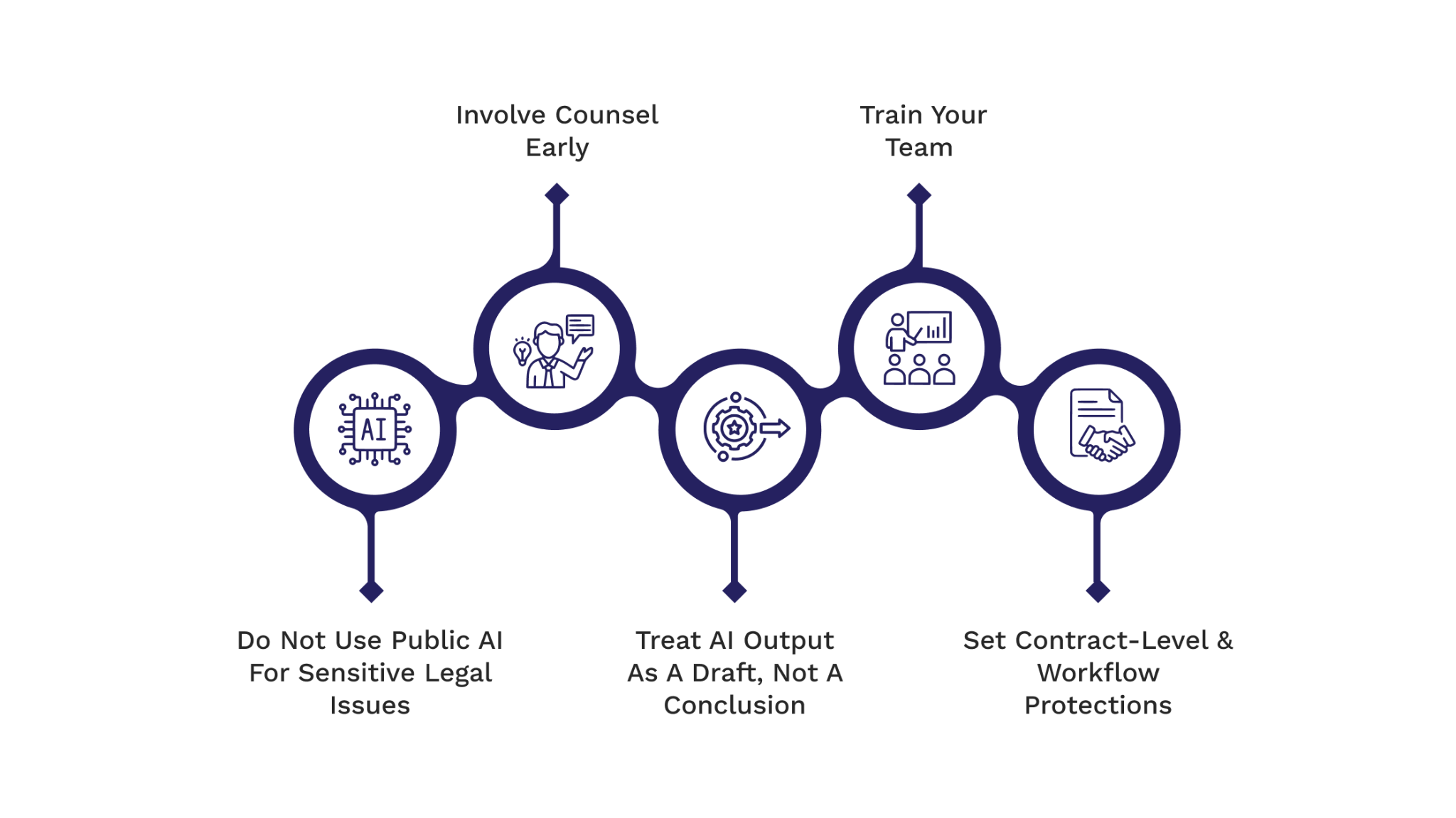
You don’t need to stop using AI. You just need clearer rules for when it belongs in the process and when it does not.
- Do Not Use Public AI for Sensitive Legal Issues
Keep these topics out of public tools:
- Facts about an active dispute
- Tax positions under review
- Investigation details
- Internal business conflicts
- Personal or financial facts tied to legal advice
If the issue could end up before a judge, regulator, or auditor, do not put it into an open AI system.
- Involve Counsel Early
Bring legal counsel in before you generate materials about:
- A transaction
- A restructuring
- A dispute
- A tax planning move
- An estate or succession issue
These steps change how a case record is created and how a court may view it.
- Treat AI Output as a Draft, Not a Conclusion
AI output may look complete even when it is wrong, incomplete, or poorly framed. A polished answer does not make it accurate. It also does not make it privileged. Use AI to organize questions or summarize public information. Do not treat it as a substitute for legal judgment when the issue carries real exposure.
- Train Your Team
This risk does not stop with ownership. Employees, contractors, paralegals, operations staff, and finance personnel all handle information that may carry legal consequences. A short internal AI policy should address:
- What data cannot be entered?
- Which tools are approved?
- When legal review is required?
- How should sensitive drafts be handled?
- Set Contract-Level & Workflow Protections
If your company uses AI often, your legal workflow should cover:
- Approved communication channels
- Confidentiality expectations
- Data-handling rules
- Client use of AI tools
This is where AI and legal profession concerns become operational. The goal is not to ban AI. The goal is to keep legal analysis inside protected channels whenever protection matters.
What Business Owners Should Take from the Heppner Case
AI is changing how legal work starts. It is not changing the rules around attorney-client privilege, confidentiality, or work product. Business owners should take three points from Heppner:
- AI does not replace protected legal advice
- Artificial intelligence in law creates risk when used by outside counsel
- The process decides whether sensitive analysis remains protected or becomes evidence
If you use AI for contracts, tax planning, disputes, or estate planning, control the workflow before the workflow controls your exposure.
Know the Legal Risk Before You Use AI

If you are using AI to think through contracts, tax moves, disputes, or succession planning, review that process before it creates exposure. Dahl Law Group helps business owners structure legal analysis more carefully, protect confidential communications, and align planning with long-term business goals.
FAQs
- Are AI-generated legal documents protected by attorney-client privilege?
No, if you create them independently outside communication with an attorney, privilege usually does not apply.
- Can AI research be subpoenaed?
Yes, materials created through public AI tools may become discoverable in litigation, audits, or investigations.
- Does sharing information with AI break confidentiality?
It can weaken confidentiality when the platform acts as a third party, and the information is entered without attorney supervision.
- Is AI use allowed in legal matters?
Yes, the legal risk depends on how the tool is used, who directs it, and how confidential information is handled.
- Can work product protection apply to AI-generated content?
Usually not when the content was generated independently rather than at counsel’s direction within legal representation.
- Should businesses restrict employee AI use?
Yes, clear internal policies reduce the risk of exposing legal strategy, sensitive facts, and inconsistent written records.

Dahl Law Group
Latest posts by Dahl Law Group (see all)
- 7 Asset Protection Strategies California Business Owners Must Consider - August 14, 2026